
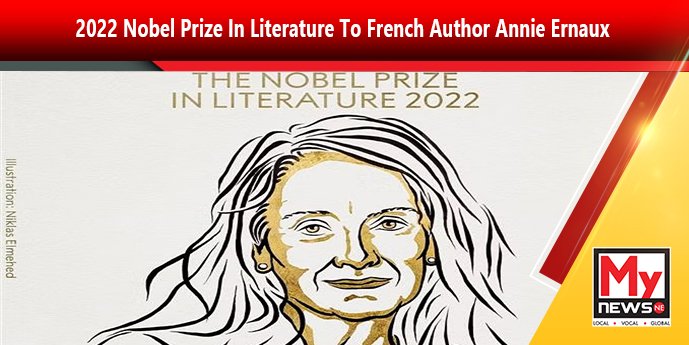

Guwahati: French author Annie Ernaux has been given the 2022 Nobel Prize in Literature in recognition of her “courage and clinical clarity with which she discovers the roots, estrangements, and collective restrictions of human memory.”
Ernaux was born in 1940, and she grew up in the Normandy village of Yvetot, where her parents had a grocery store and café. Her upbringing was modest but aspirational; her parents had risen from proletariat squalor to a bourgeois existence; and although memories of battered earth floors never completely vanished, politics were hardly discussed.
Ernaux constantly and from many perspectives investigates a life characterised by significant differences in terms of gender, language, and class in her literature. Her journey to authorship was tough and protracted.
Her rural upbringing-related memory work first emerged as a project that aimed to expand the definition of literature beyond narrowly defined fiction. She claims that she is a “ethnologist of herself” rather than a fiction writer while having a classic, recognisable style.
In her debut novel, “Les armoires” vides (1974; “Cleaned Out,” 1990), Annie Ernaux began exploring her Norman heritage. However, it wasn’t until her fourth book, “La place” (1983; “A Man’s Place,” 1992), that she achieved literary success. She created a detached portrayal of her father and the complete social environment that had fundamentally shaped him in just a few hundred pages.
Her evolving restrained and morally driven aesthetics, where her style has been fashioned hard and transparent, were applied in the photograph. It signalled a number of autobiographical writing works that went beyond the fictional universes. Additionally, if a narrative voice does exist, it is impartial and, to the best of its ability, anonymous.
Moreover, Ernaux has inserted reflexions about her writing, where she distances herself from “the poetry of memory” and advocates une écriture plate: plain writing which in solidarity with the father evinces his world and his language. The concept écriture plate is related to le nouveau roman in France from the 1950s and the striving towards what Roland Barthes called a “zero degree of writing”. There is however also an important political dimension in Ernaux’s language. Her writing is always shadowed by a feeling of treason against the social class from which she departs. She has said that writing is a political act, opening our eyes for social inequality. And for this purpose she uses language as “a knife”, as she calls it, to tear apart the veils of imagination. In this violent yet chaste ambition to reveal the truth, she is also an heir of Jean-Jacques Rousseau.
The clinically restrained story of a 23-year-old narrator’s illegal abortion, “L’événement” (2000; “Happening” 2001), is a masterwork from her production. Since it is a first-person account, the separation from the historical self is not as prominently emphasised as it is in many other works. The moral constraints of a restrictive society and the patronising demeanour of those she encounters yet turn the I into an object.
It is a brutally honest text in which she inserts reflections in a very clear voice while simultaneously addressing the reader. We are in the period of writing, 25 years after the “incident,” making even the reader feel deeply a part of what formerly transpired in the pauses between.
It is clear that Annie Ernaux believes in the empowering power of writing. Her writing is straightforward, uncompromising, and bare-bones. And she has accomplished something admirable and enduring when, with tremendous bravery and clinical acuity, she describes the misery of the experience of class, articulating shame, humiliation, jealousy, or the incapacity to see who you are.