
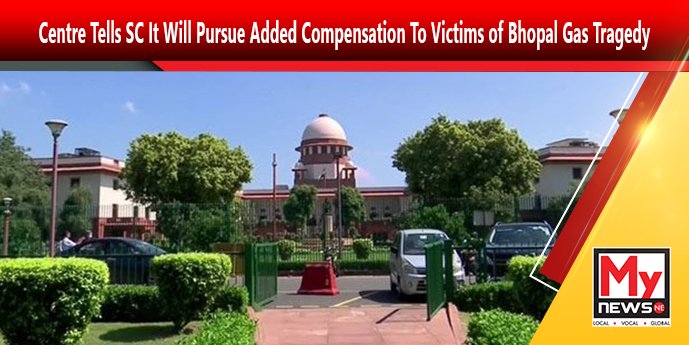

Guwahati: The Central Government informed the Supreme Court on Tuesday that it would proceed with its curative petition, which asked for an additional Rs 7,400 crore from the companies that succeeded the US-based Union Carbide Corporation, which is now owned by Dow Chemicals, in order to pay compensation to the victims of the 1984 Bhopal Gas tragedy.
Attorney General R. Venkataramani’s submission was noted by a five-judge constitution bench which is led by Justice Sanjay Kishan Kaul who also ordered the Center to create a compilation in this respect within eight weeks.
According to the supreme court the matter will now be heard on January 10, 2023.
The bench also comprising Justices Sanjiv Khanna, Abhay S Oka, Vikram Nath and JK Maheshwari in its order said, “The Attorney General has taken a stand before us that the government would like to press the curative petition. A number of NGOs would like to be impleaded. However, counsel for respondents has questioned the maintainability of the petitions as they have come 19 years after the judgement.”
The apex court had earlier asked the Centre to clarify its stand on whether it wants to go ahead with its curative petition filed by the previous government in 2010 seeking additional funds for the compensation to the victims of 1984 Bhopal Gas Tragedy.
In its curative petition for increased compensation for the victims the Centre requested that Union Carbide and other companies be ordered to pay over Rs 7,400 crore more than the earlier settlement amount of USD 470 million (RS 715 crore at the time of settlement in 1989) in order to compensate the victims of the gas tragedy.
The government argued that the 1989 settlement was substantially compromised and requested a re-examination of the Supreme Court’s order from February 14, 1989, which set compensation at USD 470 million.
The Central government argued that the compensation which was decided in 1989, was reached on the basis of truth-based assumptions unrelated to reality.
Numerous thousand people perished in the Bhopal gas tragedy, dubbed the deadliest industrial accident in history, after a fatal gas leak occurred from the Union Carbide India Limited pesticide facility on the intervening night of December 2 and 3, 1984.
Methyl isocyanate (MIC), a highly hazardous and toxic gas, leaked from Union Carbide India Limited (UCIL) in Bhopal, Madhya Pradesh, causing a disaster that resulted in 5,295 fatalities, 5,68,292 injuries, as well as the loss of cattle and about 5,478 people’s possessions.
The Central Bureau of Investigation (CBI) submitted a curative plea in 2010 asking for the augmentation of penalty but the Supreme Court has denied it. In response to public anger over a Bhopal court decision that sentenced Union Carbide officials to two years in prison and the agency moved the Supreme Court. Keshub Mahindra, a former chairman of Union Carbide India was among those found guilty.
The top court had stated that “no satisfactory justification has been presented to file such curative petitions after roughly 14 years from the 1996 judgement,” dismissing the CBI’s curative argument in 2011.