
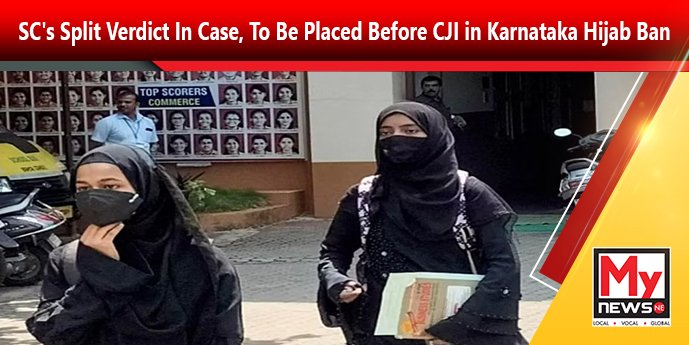

Guwahati: The Supreme Court issued a divided decision in the Karnataka Hijab Ban case on Thursday.
The verdict was delivered today by a bench of justices Hemant Gupta and Sudhanshu Dhulia.
Justice Hemant Gupta dismissed the decision while Justice Sudhanshu Dhulia approved the petition.
One of the attorneys for the petitioner stated that the Chief Justice of India will hear the case and determine whether to convene a fresh bench to hear it or refer it to a larger court.
The Karnataka High Court’s ruling upholding the state government’s directive to forbid the wearing of hijabs in the state’s educational institutions was challenged in appeals, which Justice Hemant Gupta dismissed.
Justice Gupta said, “There is a divergence of opinion. In my order, I have framed 11 questions. First is whether the appeal should be referred to the Constitution Bench.”
Justice Sudhanshu Dhulia granted the appeals and reversed the Karnataka High Court’s decision.
“It’s a matter of choice, nothing more nothing less,” Justice Dhulia said while pronouncing the order.
The Supreme Court had previously reserved its decision on several petitions challenging the Karnataka High Court’s decision to uphold the ban on hijab in educational institutions.
The petitioners’ lawyers argued for 10 days, while Solicitor General Tushar Mehta, Additional Solicitor General KM Nataraj, and Karnataka Advocate General Prabhuling Navadgi argued for the respondents.
The court was hearing various petitions challenging the Karnataka High Court’s decision to uphold the Karnataka Government’s decision to direct educational institutes to prescribe uniforms.
Senior Advocate Dushyant Dave told the court in his rejoinder submission that the Karnataka Government Circular that enforced the dress code made no mention of the Popular Front of India (PFI).
Several petitioners have petitioned the Supreme Court, challenging the Karnataka High Court’s order upholding the Karnataka government’s order directing strict enforcement of uniform rules in schools and colleges.
One of the appeals in the top court has alleged “step-motherly behaviour of government authorities which has prevented students from practising their faith and resulted in an unwanted law and order situation”.
The appeal said the High Court in its impugned order “had vehemently failed to apply its mind and was unable to understand the gravity of the situation as well as the core aspect of the Essential Religious Practices enshrined under Article 25 of the Constitution of India”.
A Karnataka High Court bench comprised of Chief Justice Ritu Raj Awasthi, Justice Krishna S Dixit, and Justice JM Khazi previously held that the prescription of uniform is a reasonable restriction to which students cannot object and dismissed various petitions challenging a ban on hijab in educational institutions as without merit.
The hijab controversy erupted in January of this year when the Government PU College in Udupi allegedly denied entry to six girls wearing the hijab. Following this, the girls sat outside the college in protest of being denied entry.
Following this, boys from several colleges in Udupi began wearing saffron scarves to class. This protest spread to other parts of the state, resulting in protests and agitations in a number of places in Karnataka.
Because of this, the Karnataka government mandated that all students wear the uniform and outlawed the hijab and saffron scarves until a panel of experts made a decision.
The pre-University education board issued a circular on February 5 informing students that they may only wear the uniform that had been approved by the school administration and that other religious clothing would not be permitted in institutions.