
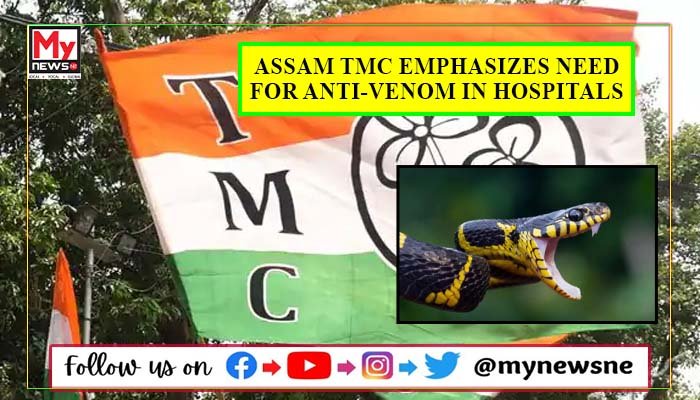

Guwahati, 14th August: In Assam, cases of snake bites are rapidly rising. Several cases of snake bites and deaths have been recorded around the state as a result of the recent floods and the ongoing monsoon season.
To draw attention to this, the Trinamool Congress (TMC), Assam chapter, emphasized on Sunday the need for anti-venom and emergency facilities for situations involving snake bites.
Assam Trinamool Congress Media President Dilip Kumar Sarma requested the Assam government to establish anti-venom and emergency rooms in all public hospitals to help anyone bitten by venomous snakes in a statement to the media.
Sarma also brought up a recent girl who died after being bitten by a snake in Assam’s Baksa district.
Furthermore, Dilip Kumar Sarma recommended that the Assam government instruct the state’s private hospitals to make the necessary measures.
The horrifying extent of the snakebite epidemic in Assam, India’s biodiversity hotspot, was revealed by a recent ground-breaking study conducted by a group of scientists and clinicians from Demow Community Health Center in Assam, part of the Institute of Advanced Study in Science and Technology (IASST). A neglected tropical disease (NTD), snakebite disproportionately affects vulnerable populations in underdeveloped rural areas with poor access to healthcare.
The published estimate of 5.4 million snakebite cases per year worldwide, according to the World Health Organization (WHO), significantly underestimates the true scope of the issue in the Indian subcontinent, particularly in Assam. Among the poisonous snakes present in the area are the Indian monocled cobra, banded krait, greater black krait, lesser black krait, king cobra, green pit viper, and Salazar’s pit viper. Unfortunately, accurate public health planning and resource allocation are difficult due to the dearth of reliable snakebite data.