
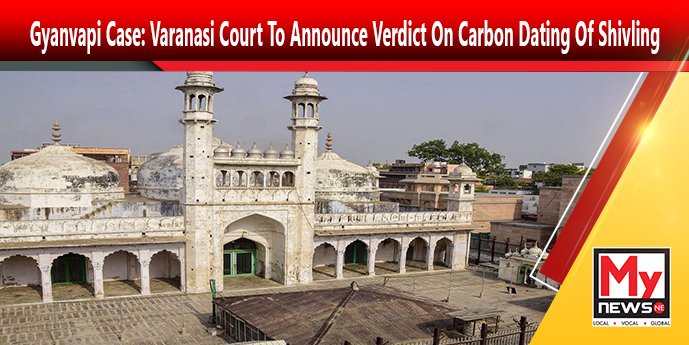

Guwahati: The Varanasi court will rule on the Hindu side’s request for carbon dating of the structure discovered inside the Gyanvapi mosque that they claimed to be a “Shivling,” according to attorneys for the Hindu and Muslim sides on October 14.
After postponing the case until October 11, the court heard from the Muslim side yesterday.
Speaking to national media on behalf of the Hindu side, Vishnu Jain said: “Shivling is not a piece of the suit property, according to the Muslim side, and its carbon dating cannot be done. We have clarified our position on both of these issues. The court’s decision will be announced on October 14.”
The Muslim side’s attorney, Akhlaq Ahmed, said that the Hindu side’s argument could not stand since it violated the Supreme Court’s ruling protecting the edifice (which the Muslim side claims to be a fountain and the Hindu side claims to be a Shivling).
“We responded to the application on carbon dating. Stone does not have the capacity to absorb carbon. The Supreme Court in its May 17 order, according to which, the object that was found by the commission, had to be protected. The order of the SC will prevail, so the object cannot be opened. According to the Hindu side, the process will be scientific, even if it is so, there will be tampering with the object. Chemicals will be used for the test. We will take action based on the order by the court on October 14,” Ahmed added.
Another lawyer representing the Muslim side, Tohid Khan said, “The court will deliver its verdict on whether the application seeking carbon dating is acceptable or should be rejected. The structure is a fountain and not Shivling. The fountain can still be made operational.”
After hearing arguments from both sides earlier on September 29, the court reserved the decision in the Gyanvapi Mosque-Shringar Gauri case.
A “Shivling,” according to the Hindu side, was allegedly discovered during the court-ordered videography investigation of the mosque grounds in the area next to the “wazukhana.” The discovered building, according to the Muslim side, was a “fountain,” though. On September 22, the Hindu side had made a request for a carbon date of the object they claimed to be the “Shivling.”
The age of an archaeological object or find can be determined scientifically using carbon dating.
The Hindu side demanded that the Archaeological Survey of India (ASI) conduct a scientific inquiry of the “Shivling” and carbon date the “Argha” and the vicinity on September 29.
Earlier, an appeal against the Allahabad High Court’s decision to reject a PIL that asked for the creation of a committee or commission headed by a judge to investigate the nature of the structure uncovered in the Gyanvapi Mosque in Varanasi had been filed before the Supreme Court.
In their request, seven worshippers urged the Archeological Survey of India (ASI) to determine the type of building on the Gyanvapi site.
On July 19, the Allahabad High Court rejected their request for the creation of a committee or commission to investigate the structure uncovered in the Gyanvapi Mosque. The committee or commission would have been led by a sitting or retired judge of the High Court or Supreme Court.
The Public Interest Litigation brought before the High Court requests guidance from a committee to determine if a fountain, as Muslims allege, or a Shivaling, as claimed by Hindus, had been discovered inside the mosque.
The Allahabad High Court erred in denying the plea according to the appeal at the highest court.
The Supreme Court issued an order transferring the civil judge’s civil case involving worship at the Gyanvapi mosque to the Varanasi District Judge on May 20 .